
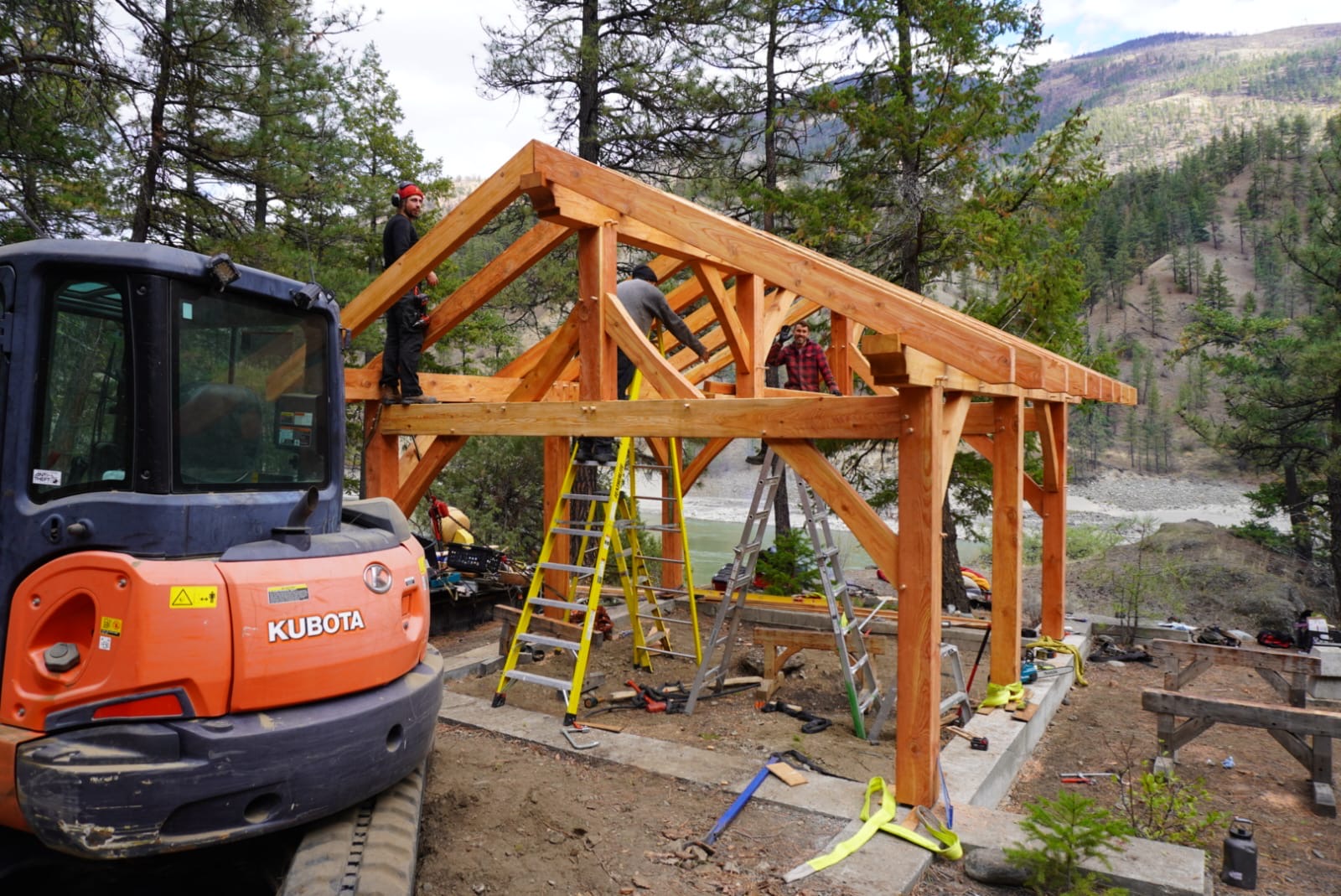
Wall assemblies for the community
Before joining Beyond Efficiency as an HVAC engineer and envelope consultant, I spent five years working as a traveling carpenter. I moved between companies and saw a breadth of different building styles from high-end custom homes to production-level tract homes. Along the way, I met some builders who shared a common passion for creating small homes for friends and families at the lowest cost possible.
On weekends or between jobs, we would come together and recruit as many willing volunteers as we could. Building materials came from jobsite leftovers, local auctions, Facebook marketplace or the surrounding forest. These considerable constraints on budget, materials, and experienced labor allowed us to learn how different assemblies could meet code requirements and which would work for a community effort. Wall construction types on these homes have included wood studs, insulating concrete forms (ICFs), and timber frames with strawbale infill. Strawbale was the only system the community could provide at very low cost and was the easiest for inexperienced builders to work with.
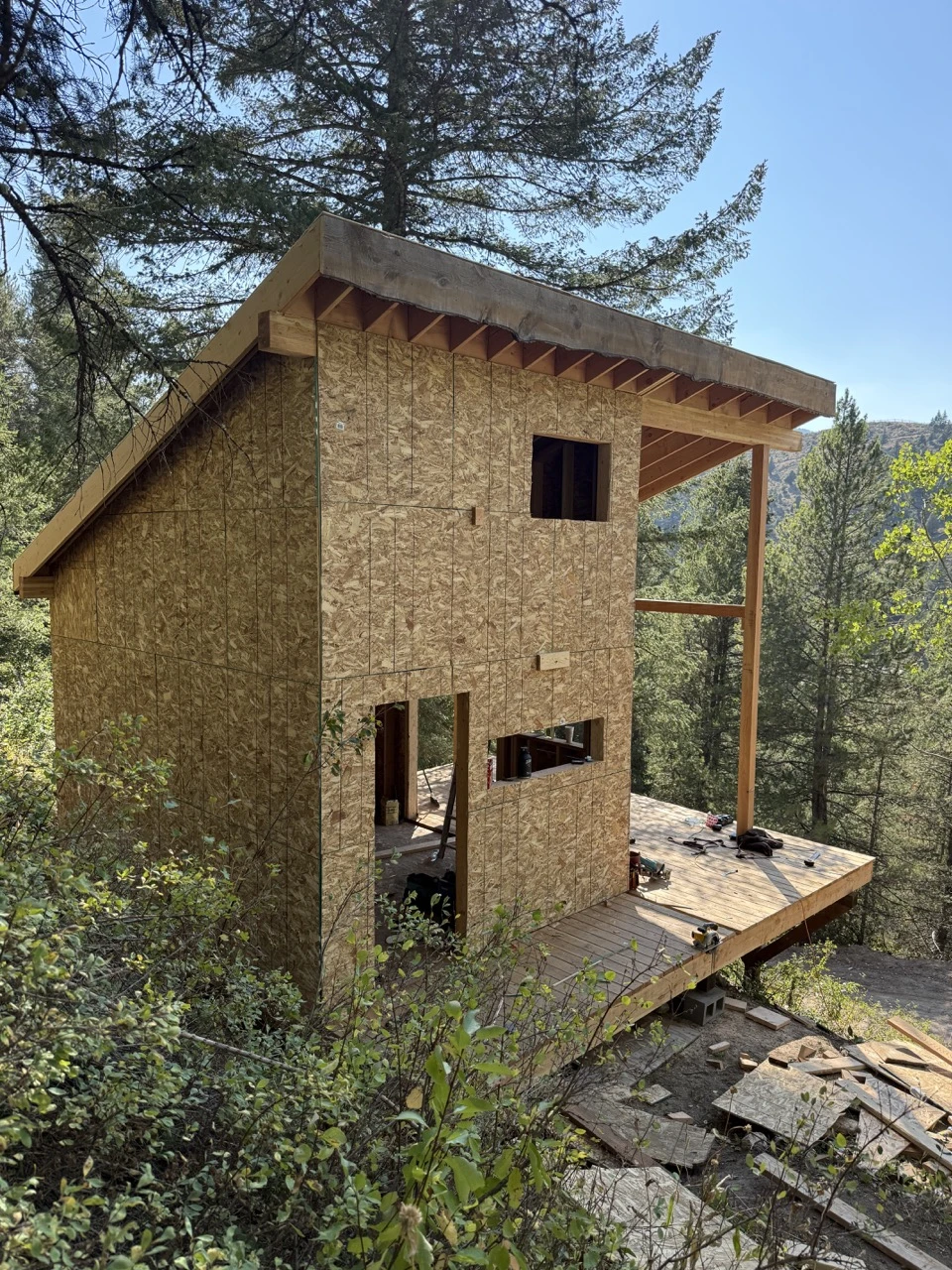
What’s different about strawbale walls?
Cost
First and foremost, the reason for large cost savings with strawbale is that we could convince community members to donate materials (straw, clay, and sand). Folks tended to be stingier with their stashes of ICF blocks and rockwool batts.
Vapor control
Next, water vapor drive and control in strawbale walls differs from other assemblies in code requirements and building techniques. Permeance, or a material’s ability to resist vapor transmission, is measured in Perms and represents how much water vapor passes through a unit area of the test material in one hour. The properties of vapor control layers in a wall can be compared to wearing an old-school rubber raincoat with a new technical fabric that is intended to breath. That is not to say that one jacket, or vapor control layer, is better than the other. They have different physical properties that must be planned for accordingly.
Classes of vapor control layers:
• Class 1 – Vapor Impermeable – less than 0.1 perms (vapor barrier, e.g. polyethylene sheet)
• Class 2 – Vapor Semi-Impermeable – 0.1 to 1.0 perms (vapor retarder, e.g. 2” XPS)
• Class 3 – Vapor Semi-Permeable – 1.0 to 10 perms (vapor retarder, e.g. plywood)
• Not a vapor control layer – Vapor Permeable – greater than 10 perms (vapor open, e.g. unpainted drywall)
Strawbales meet code requirements differently and can be forgiving for inexperienced builders. All the structures I have worked on have been in IECC climate zones 4 through 6 and require some form of vapor control to reduce condensation risk in cold weather. These details will change depending on the project’s climate zone, especially for those in cooling dominated climate zones 1 or 2. For now, let’s keep it simple and review vapor control requirements for a cavity-only insulated stud frame wall in climate zones 4-6 (cold):
1. Exterior cladding
2. Weather resistive barrier (vapor permeable)
3. Structural plywood (vapor semi-permeable)
4. 2x6 wood studs with air-permeable cavity insulation (vapor permeable)
5. Class 1 or 2 vapor control layer (vapor impermeable or semi-impermeable)
6. Interior finish (vapor semi-permeable)
This modern building technique is quick and reliable when done right. It’s straightforward to assemble, but the plywood sheathing requires extra care when applying the outer water and air barrier. Ideally, the outer layer is airtight to minimize air and moisture from entering the wall assembly from infiltration or exfiltration. The interior vapor retarder should also be airtight and adequately continuous to limit moisture migration through air leaks as well as vapor diffusion through the walls. The hiccups we encountered with this wall assembly included sourcing the expensive engineered materials and teaching inexperienced volunteers how to properly install these layers. Without proper materials and with poor installation, this assembly can face major moisture concerns from condensing water vapor and limited drying potential, especially with the use of a Class 1 interior vapor barrier. So, what about strawbales?
A typical zone 6 strawbale wall assembly is well documented by the 2024 International Residential Code Appendix BJ. Required layers from the exterior to interior are:
1. Plaster exterior finish with perm rating of 5 or greater (vapor semi-permeable to vapor open)
2. Strawbales placed on edge or laid flat
3. Plaster interior finish with perm rating 1-10 (Class 3 vapor retarder)
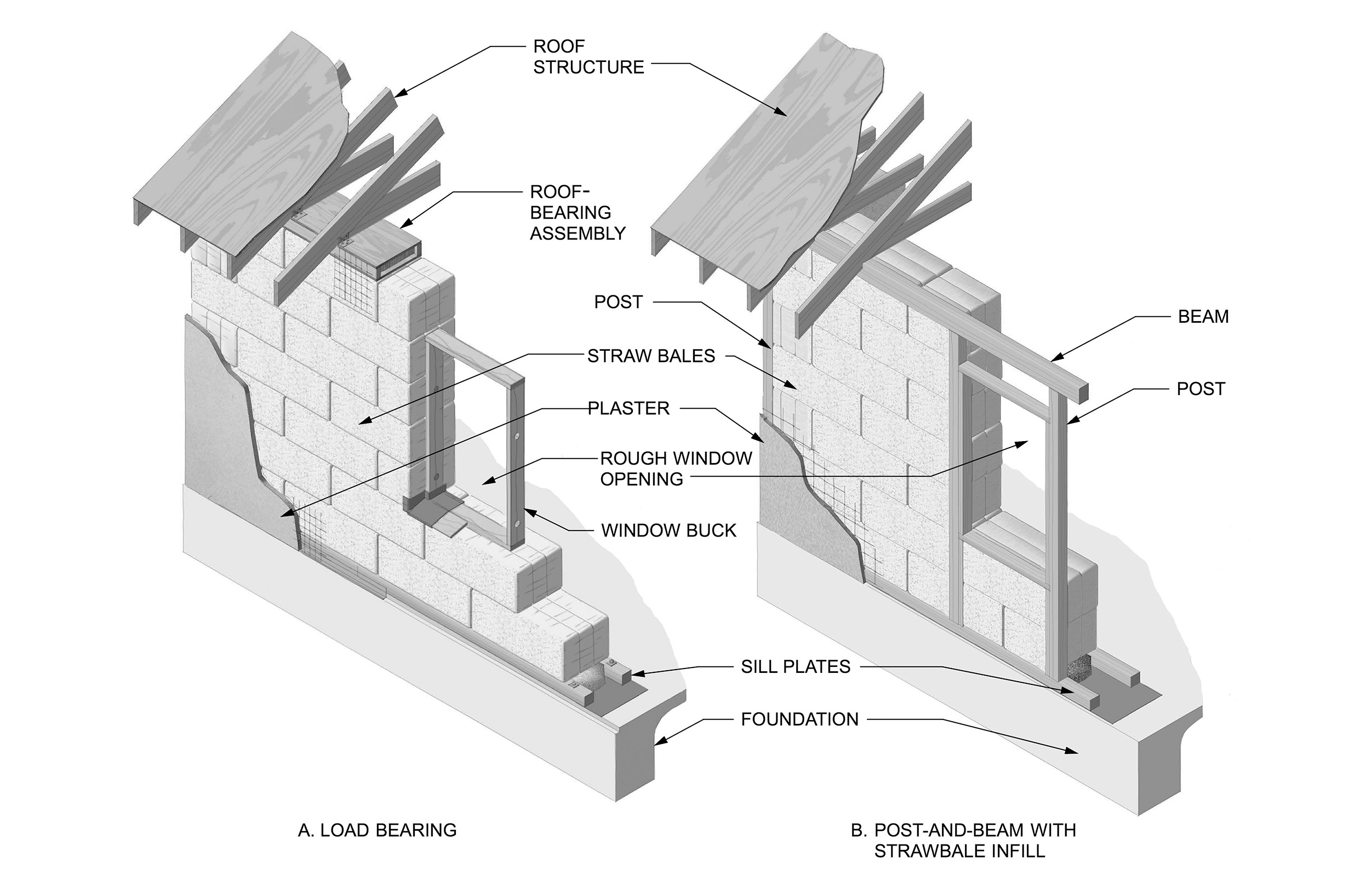
Typical strawbale wall systems from IRC 2024
Compared to stud framing, this traditional building technique is slower and more labor intensive. Fortunately, people are willing to serve their friends and family, so time and costs are generally not an issue. For us the strawbale wall shined because inexperienced members grasped the techniques quicker, the results were easier to check or correct, and we found poor applications to be more forgiving.
A benefit of strawbale wall assemblies is that the plaster finishes also serve as the air and vapor control layers, so no control layer gets hidden. Any poorly sealed penetrations or transitions can be remedied with minimal reconstruction. Now, what about the mistakes that don’t get caught or corrected? I can assure you, they are there. This is where we have appreciated the forgiving nature of strawbales. These walls stay vapor open and the strawbales themselves act as a hygric buffer: the assemblies can safely store and transfer large amounts of water vapor. Compared to stud-framed walls, we felt more comfortable with strawbale walls without perfectly installed air and vapor control layers.
Bulk water
As forgiving as strawbale walls are for air and vapor, they are less forgiving when it comes to bulk water. Managing rainwater exposure to walls should be primarily handled by large eaves and proper flashing around windows and doors, first planned at the design stage. It should be understood that exterior lime plasters will not hold up as well as modern water resistive barriers. The exterior plaster also requires more frequent inspection since it is exposed to the elements and requires maintenance.
Capillary break
Another area that requires more concern than a stud frame wall is the capillary break required at the base of a strawbale. Stud frame walls can be installed directly to a concrete slab or stem wall with pressure treated wood sill plates and a foam or other type of seal under the sill plates. Per BJ105.6.5 Separation of Bales and Concrete from the 2024 IRC, strawbale wall assemblies require the foundation surface to be covered by a sheet or liquid applied class 2 vapor control layer. Then, the bottom of the strawbales must rest at least ¾” above the concrete. This space must be filled with an insulating material (e.g. rigid insulation) or one that allows vapor dispersion (e.g. gravel). These details require more planning and materials than the stud frame sill plate.
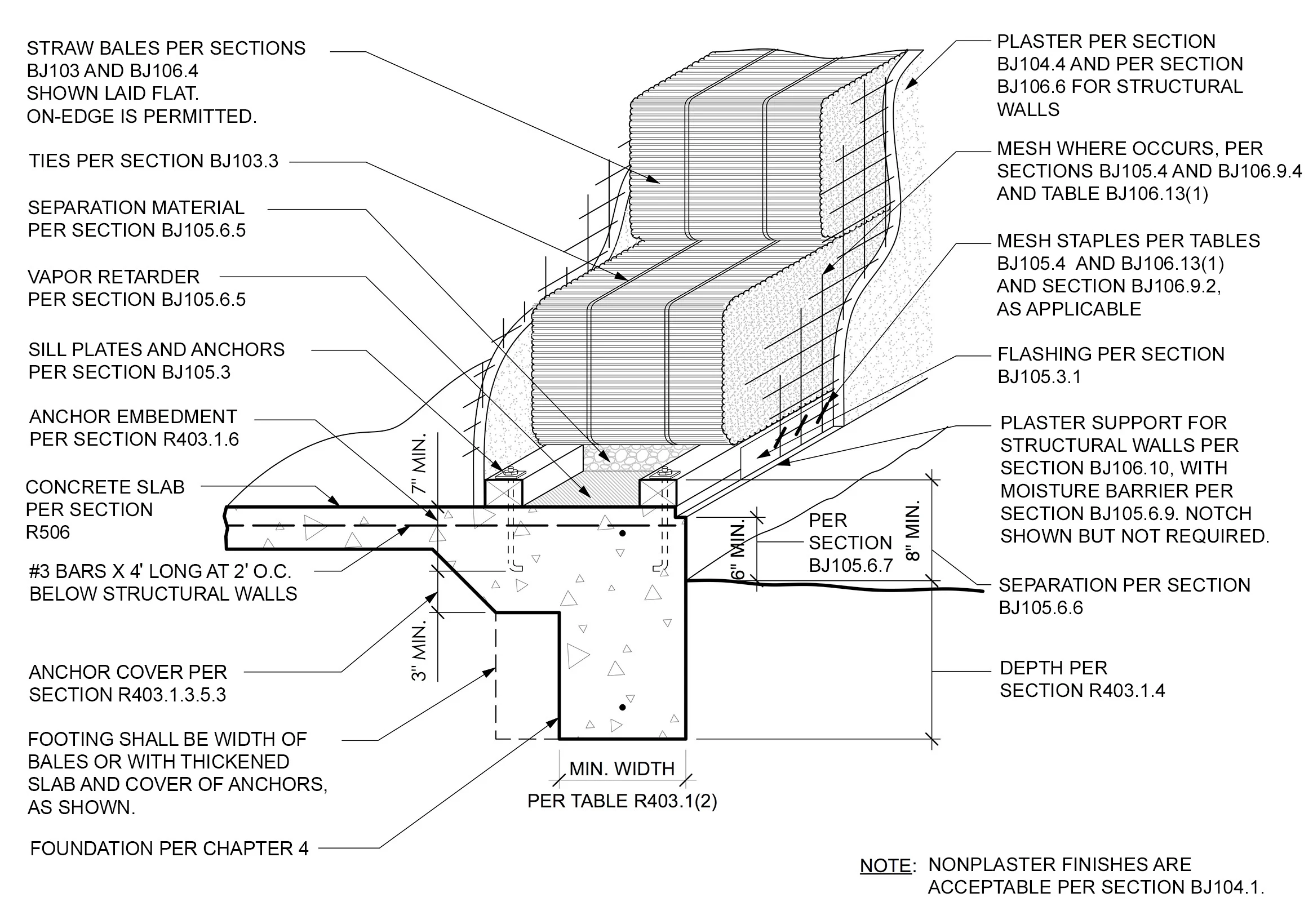
Typical strawbale base details from IRC 2024
What does this mean for you?
Strawbale isn’t for everyone, and I am by no means making a statement on what the building industry should be doing. I am an engineer and builder who enjoys both construction and building science. Even more, I enjoy seeing communities work together to house themselves at minimal costs. I believe that understanding building physics allows individuals to make design decisions that accommodate limited resources and experience. I encourage anyone who is about to start a project to search for reclaimed materials and reach out to neighbors for materials or assistance. You might reduce the cost of your project and expand your community at the same time!
Category: